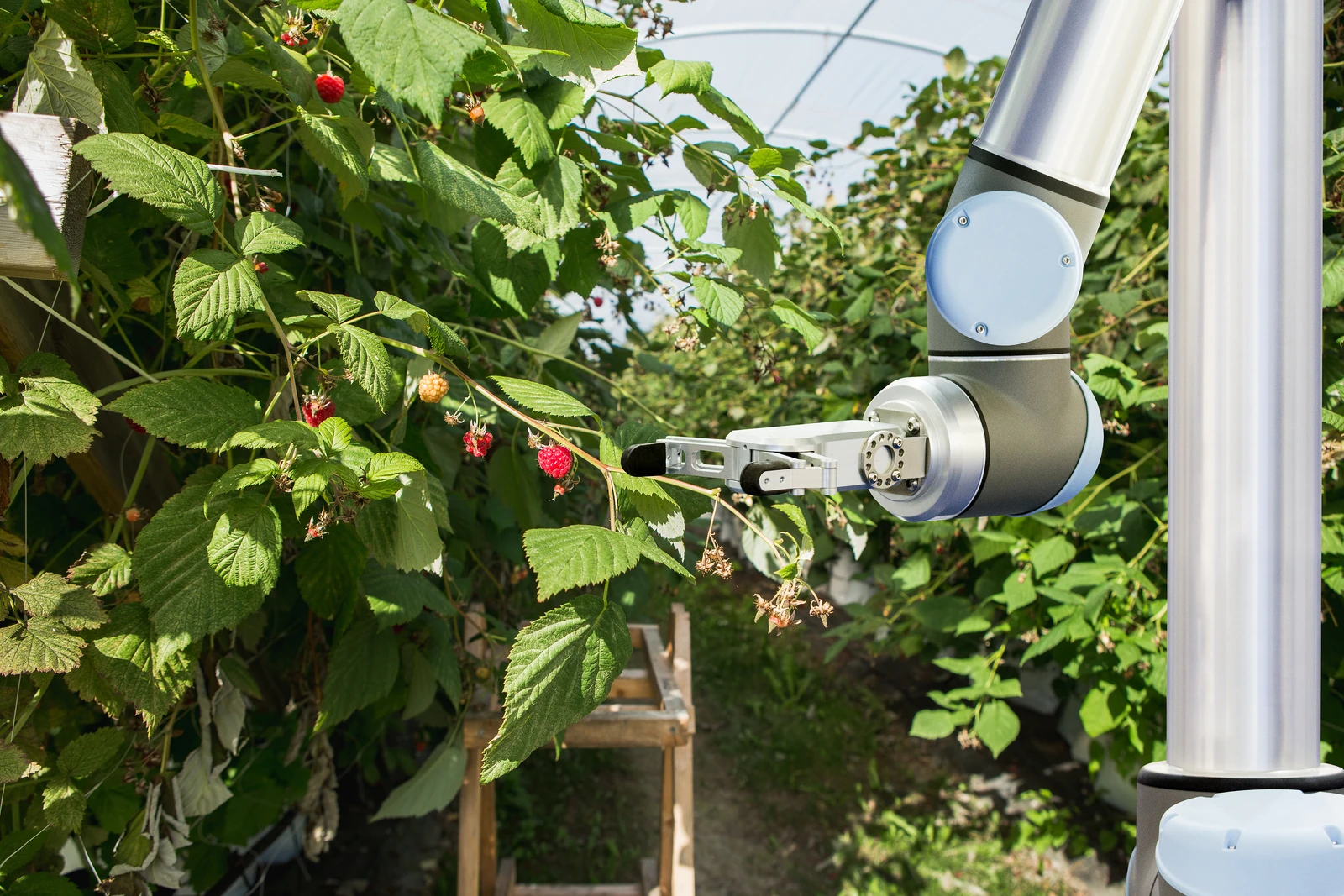
Agricultural robotics did not become one uniform mass market in 2025. Adoption varied by crop, farm size, terrain, labor availability, season length and task economics. Drones, autonomous tractors, weeding platforms, greenhouse systems, harvesting machines, milking robots and inspection devices have different maturity and purchasing models.
This review treats 2025 as the reference year and incorporates public information available through July 2026. Market-size and penetration figures should not be combined unless they use the same definition; some reports include drones and automated machinery, while others count only mobile service robots. The more useful question is which workflows can deliver repeatable agronomic and economic value.
The Policy Boundary Through July 2026
China’s National Smart Agriculture Action Plan for 2024–2028 emphasizes digital infrastructure, large-area crop productivity, smart farms, livestock and aquaculture, and full-chain digital transformation. It sets targets for agricultural production informatization, not a guaranteed market size for robots.
In June 2026, the Ministry of Industry and Information Technology and the Ministry of Agriculture and Rural Affairs launched selection of typical agricultural robot application scenarios. That shows continued emphasis on demonstrable use cases. It does not prove that every robotic task had reached large-scale commercial deployment.
Segment the Market by Job and Environment
Field-crop systems may handle mapping, tillage, seeding, spraying, weeding and harvest support. Orchard and greenhouse platforms add narrow rows, branches, variable lighting and delicate crops. Livestock systems focus on feeding, milking, cleaning, health observation and material handling. Aquaculture adds water, corrosion and communication constraints.
Post-harvest robots can sort, pack and move products in more structured environments. They may achieve higher utilization and easier localization than a machine that operates for only a short outdoor season. Market comparisons should separate these operating models.
Adoption Economics Begin with Utilization
Calculate productive hours per season, acres or units served, setup time, transport, charging or fueling, supervision, consumables and maintenance. A robot with strong laboratory performance may have weak economics if it cannot move between fields, adapt to crop variation or receive timely service.
Compare ownership, leasing and robotics-as-a-service models. Contractors can spread equipment cost across farms, while farm ownership can provide scheduling control. Include crop damage, missed operations and downtime risk, not only labor substitution.
Perception Must Work in Agricultural Variability
Cameras, depth sensors, radar, lidar, GNSS, inertial sensors and plant or soil measurements can support localization and task decisions. Dust, fog, rain, glare, shadows, moving leaves and crop growth change the sensing problem. A model trained on one variety or field may not generalize to another.
Validation should report crop, growth stage, lighting, weather, terrain and obstruction. Measure false positives, missed targets, positioning error and recovery behavior. Maintain calibration through vibration, cleaning and sensor replacement.
Mechanisms and Tools Determine Agronomic Results
The mobile base only positions the work tool. Spraying, cutting, grasping, weeding, planting or sampling requires task-specific force, accuracy and timing. Soil and plants are deformable and variable, so tool design and control need representative field trials.
Evaluate throughput together with crop damage, chemical placement, missed area and rework. A high-speed demonstration is not useful if the system needs frequent human resets or creates unacceptable agronomic outcomes.
Energy and Thermal Design Affect the Mission
Traction, pumps, manipulators, compute and sensors compete for energy. Battery runtime varies with terrain, payload, temperature, tool duty and aging. Charging logistics and safe field handling can limit daily utilization more than nominal capacity.
Record continuous and peak loads, regenerative behavior and fault energy. Protect high-current paths, monitor temperature and design connectors so operators cannot create unsafe energized mating. Provide recovery when the machine stops far from a service point.
Interconnects Face a Harsh Combination
Agricultural connectors and cable assemblies may encounter dust, mud, fertilizer, pesticides, water, ultraviolet light, vibration, impact, rodents and repeated attachment changes. An IP code addresses defined ingress testing, not all of those exposures. Materials and seals require separate compatibility evidence.
Route harnesses away from moving tools and pinch points, support cable mass and allow the correct bend or torsion. Use coding and labels to prevent attachment errors. For data, preserve pair geometry and shield termination; for power, measure voltage drop and temperature with simultaneous loads.
Connectivity Should Survive Loss of Coverage
Cloud services can support fleet planning, maps, agronomic records and software updates, but essential safety and stop functions should not depend on continuous public-network coverage. Define local autonomy, communication-loss behavior, data buffering and secure recovery.
Remote updates need version control, compatibility checks, integrity protection and rollback or recovery. Seasonal equipment may remain offline for months, so maintenance must address expired credentials, battery condition and skipped releases.
How to Evaluate a Pilot
| Measure | Why it matters |
|---|---|
| Task quality | Coverage, accuracy, crop damage, missed targets and rework |
| Productivity | Useful output after setup, charging, cleaning and recovery |
| Availability | Failures, repair time, spares and remote support |
| Adaptability | Performance across crops, fields, weather and operators |
| Safety | Detection, stopping, human interaction and fault response |
| Economics | Total seasonal cost and value under realistic utilization |
Engineering Release Checklist
- Define task, crop, terrain, weather and operator boundary.
- Set agronomic, productivity and safety acceptance criteria.
- Validate perception and tool performance across representative variation.
- Test energy, thermal and communication-loss behavior.
- Age harnesses and connectors through combined field exposures.
- Run service, cleaning, attachment and storage trials.
- Monitor a pilot across a complete operating season before scaling.
WLconnectivity’s robotics connectivity overview can support system partitioning, while robotics cable assemblies can be evaluated against the field motion and exposure profile. Exact suitability needs application evidence.
Frequently Asked Questions
Did agricultural robots achieve full-cycle coverage in 2025?
Some systems connected multiple tasks, but maturity varied by crop and environment. “Full cycle” should identify the exact operations and human interventions included.
Can one market-size figure describe the sector?
No. Definitions may include or exclude drones, autonomous machinery, stationary automation and services. Methodology must be stated.
Is IP67 enough for farm equipment?
It may address a defined ingress need, but chemicals, ultraviolet exposure, mud, impact and cable motion require additional evidence.
Scale Workflows That Survive the Season
The durable 2025 trend was broader experimentation across the agricultural lifecycle, supported by policy and better sensing. Through July 2026, the strongest path to scale remains task-level proof: agronomic quality, usable productivity, field reliability and service economics. Interconnect design is part of that proof because every autonomous function depends on stable power and data in an unusually variable environment.