China has the world’s largest industrial-robot market and a rapidly expanding base of domestic robot suppliers, component makers, integrators, and application developers. That scale is significant, but it does not prove that every part of the robotics supply chain is fully domestic, technically equivalent, or free from external dependencies. A useful 2026 assessment separates measured industrial-robot installations from broader service, mobile, special-purpose, and humanoid-robot narratives—and evaluates performance at component and application level.
This review uses information available through July 2026. The International Federation of Robotics’ World Robotics 2025 release reports that China accounted for 54% of global industrial-robot installations in 2024 and had more than two million industrial robots in operation. IFR also reports that the share of domestic suppliers in China’s new industrial-robot installations rose to 57% in 2024, up from 30% in 2020. These are strong indicators of market depth, but they do not describe every robot category or the origin and capability of every component.
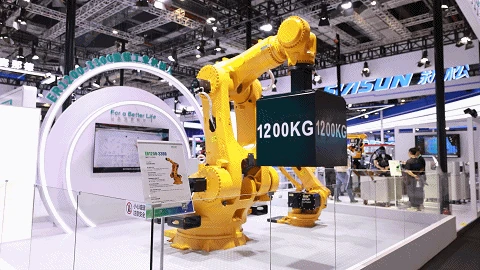
First define what is being counted
An industrial robot is not the same market unit as an autonomous mobile robot, warehouse vehicle, surgical robot, inspection platform, domestic service robot, underwater robot, or humanoid. Shipment value, deployment method, lifetime, safety obligations, and data availability differ. Reports that combine all categories into one headline market size can create false precision.
Industrial robots are relatively well measured because installations in manufacturing have established definitions and long-running datasets. Service-robot and humanoid statistics are often based on company announcements, pilot units, incomplete samples, or forecast models. Buyers should ask whether a number describes orders, shipments, installed units, active systems, revenue, or production capacity—and for which year and geography.
The industrial-robot base is both an advantage and a test
A large installed base gives Chinese manufacturers repeated opportunities to improve welding, handling, machine tending, assembly, painting, inspection, packaging, and logistics. It also creates demand for replacement parts, retrofit engineering, safety upgrades, and lifecycle support. Automotive and electronics remain major users, while metalworking, machinery, plastics, chemicals, food, batteries, and other industries present different technical and economic constraints.
Scale does not guarantee successful deployment. A robot cell can miss its target because of fixture variation, unstable incoming parts, difficult changeovers, poor vision conditions, inadequate guarding, low utilization, or weak integration with upstream and downstream processes. The correct metric is good output and lifecycle economics, not robots purchased per factory.
Map the supply chain by function
Mechanical and motion components
Reducers, gears, bearings, linear guides, ball screws, brakes, frames, and precision cast or machined parts determine stiffness, backlash, load capacity, accuracy, and life. Competitive evaluation needs measured performance over temperature, load, speed, duty cycle, shock, and wear—not only a catalog nominal.
Actuation and control
Servo motors, drives, encoders, robot controllers, real-time networks, safety systems, and motion algorithms form the motion stack. Integration quality matters as much as individual peak specifications. Tuning, trajectory planning, vibration suppression, functional safety, diagnostics, and commissioning tools affect usable performance.
Sensing and perception
Machine vision, force and torque sensing, proximity sensing, lidar, inertial sensing, and environmental perception let robots respond to variation. Lighting, calibration, contamination, latency, synchronization, and data quality can limit a perception system more than model architecture.
End effectors and process packages
Grippers, tool changers, weld guns, dispensers, screwdrivers, polishing tools, and application software turn motion into production. Many projects are won or lost at this layer because the tool must accommodate part tolerances, utilities, maintenance, and process quality.
Connectivity and energy
Power, feedback, data, pneumatic, cooling, and grounding paths move through joints, dress packs, bases, and tools. Cables and connectors face repeated bending, torsion, acceleration, oils, abrasion, and electromagnetic interference. The number of connectors per robot is not fixed; it depends on architecture and application. A suitable robotic cable assembly must therefore be engineered around motion, routing, signal, environment, and maintenance.
Where domestic capability is advancing
The rise in domestic-supplier share reported by IFR indicates growing acceptance of locally supplied industrial robots. Chinese companies also benefit from dense manufacturing clusters, short feedback loops with end users, broad electronics production, and demanding deployment volumes. In some standard and cost-sensitive applications, local suppliers can combine adequate performance with fast application support.
Progress, however, is uneven across payloads, accuracy classes, safety functions, high-end sensors, software ecosystems, and component lifetimes. A domestic brand may still use imported components, intellectual property, production equipment, or engineering tools. Conversely, a product with foreign components may include substantial domestic design and manufacturing. Procurement should analyze the bill of material and risk rather than assign capability from brand origin alone.
Humanoids are a platform experiment, not yet a single mature market
Humanoid development in China has accelerated through prototypes, pilot lines, embodied-AI research, and component investment. The potential value is adaptability in environments designed for people, but the engineering burden is high: safe dynamic motion, dexterous manipulation, battery runtime, perception, thermal management, reliability, data collection, and cost must all work together.
Factories evaluating humanoids should define a specific task and compare it with fixed automation, collaborative robots, mobile manipulators, and process redesign. Pilot success should measure cycle time, intervention rate, safe-stop frequency, recovery, uptime, training effort, and total labor required. A staged pilot is more informative than a production-capacity announcement.
A buyer’s qualification framework
- Define the use case: payload, reach, cycle, accuracy, environment, part variation, human interaction, and required availability.
- Verify safety: complete the application risk assessment, guarding or collaborative limits, safety functions, recovery procedure, and change management.
- Test representative work: include worst-case parts, shifts, lighting, contamination, network behavior, and abnormal recovery.
- Examine maintainability: spare parts, diagnostic access, cable replacement, backups, software support, training, and service response.
- Assess supply risk: second sources, component traceability, firmware ownership, export controls, security updates, and end-of-life commitments.
- Measure economics: good units, uptime, scrap, interventions, energy, floor space, and lifecycle cost—not only robot purchase price.
WLconnectivity’s robotics connectivity solutions are relevant at the subsystem boundary, where motion life, shielding, sealing, retention, and serviceability must be translated into a testable specification.
Outlook through 2030
Industrial deployment is likely to deepen in factories that can standardize processes and integrate automation with quality data. Mobile manipulation and flexible cells may gain ground where product mix changes frequently. AI will improve perception, programming assistance, maintenance, and task adaptation, but deterministic safety and process controls will remain essential.
The industry’s durable advantage will come from verified component capability, repeatable application engineering, software maintenance, and lifecycle service. Market share can change faster than field reliability is proven, so decision-makers should keep installation statistics, supplier claims, and qualification evidence separate.
Frequently asked questions
Has China achieved a fully independent robotics supply chain?
No single public metric proves that. Domestic capability and supplier share have increased substantially, but dependency varies by component, performance level, tooling, software, and application.
Does China install more industrial robots than any other country?
Yes, according to IFR’s 2024 installation data released in 2025. The figure applies to industrial robots under IFR definitions, not every type of robot.
Are humanoid robots ready for broad factory replacement?
Not as a general conclusion in July 2026. Some pilots may be useful, but each task must be compared against established automation and validated for safety, reliability, intervention rate, and cost.
China’s robotics industry has moved beyond simple volume growth. Its next test is converting scale into transparent, repeatable performance across components, systems, applications, and years of service.