Robot joint modules became a strategic focus in China during 2025 because they concentrate several performance-critical components—motor, reducer or transmission, bearings, encoder, brake, controller, thermal path, connectors, and harness—into a repeatable actuator unit. The opportunity is large only if suppliers can deliver torque density, precision, dynamic response, safety, thermal stability, lifetime, manufacturability, and cost together.
This article reframes a Chinese industry overview published on December 31, 2025. Market-size forecasts and “trillion-yuan” narratives from that period are not presented as verified July 2026 results. The useful framework is technical: evaluate modules through system evidence rather than one headline parameter.
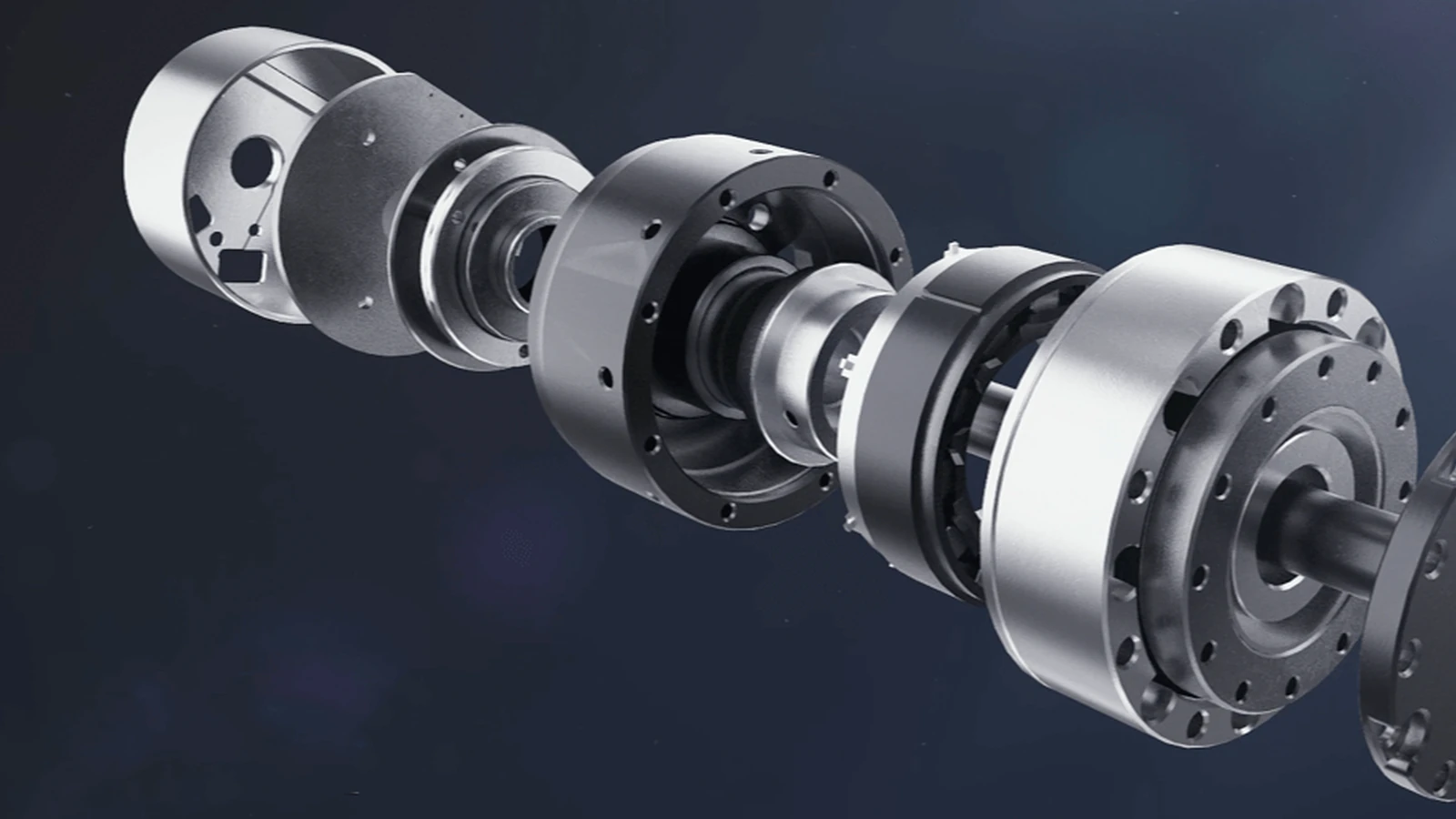
What an integrated joint module contains
| Subsystem | Function | Common tradeoff |
|---|---|---|
| Motor and drive | Generate controlled torque and speed | Torque density versus heat, efficiency and control bandwidth |
| Reducer or transmission | Transform speed and torque | Backlash, stiffness, efficiency, wear, noise and shock tolerance |
| Bearings and structure | Carry radial, axial and moment loads | Mass and compactness versus stiffness and life |
| Encoder and sensing | Measure position, speed, torque or temperature | Resolution versus accuracy, calibration, latency and robustness |
| Brake and safety features | Hold or control defined fault states | Mass, heat, response and diagnostic coverage |
| Interconnect and harness | Carry power, data, feedback and protective circuits | Size and mass versus current, bandwidth, flex life and serviceability |
Torque density is not the only performance metric
Peak torque may be available only briefly and at a specific temperature. Compare continuous torque, speed-torque envelope, efficiency, thermal resistance, cooling condition, current, voltage, mass, dimensions and duty cycle. Measure output torque at the module, not infer it only from motor data.
Precision needs multiple measures: backlash, lost motion, torsional stiffness, repeatability, absolute accuracy, hysteresis, encoder error and thermal drift. A module with low reducer backlash may still show compliance or calibration error under load.
Thermal design links every subsystem
Motor copper loss, drive switching, bearings, gears and brakes generate heat in a compact enclosure. Temperature changes lubricant behavior, magnet strength, resistance, encoder accuracy, contact performance and structural dimensions. Define ambient, duty, neighboring joints, covers, airflow or conduction paths and allowable surface temperature.
Run thermal steady-state and transient tests across representative motion. Monitor motor, drive, reducer, bearings, connectors and harness hotspots. Software derating should be predictable and included in robot-level cycle-time analysis.
Interconnect design affects density and reliability
Joint modules need battery or bus power, motor phases or local drive power, encoder and sensor signals, brakes, communication and sometimes functional safety. Partition voltage domains and manage EMC. Select conductors and contacts from loaded current, voltage drop, motion, temperature and fault energy.
Internal harnesses may bend or twist with the joint. Capture the real trajectory, radius, angle, free length and clamp points. High-speed links need controlled pair geometry, shield and PCB launches. Compact connectors must remain manufacturable and serviceable.
Localization depends on process capability
Replacing imported components is not simply a part-number exercise. Motors, gears, bearings, encoders, electronics, cables and connectors interact through tolerance, calibration, control and thermal behavior. A substitute requires module-level revalidation.
Scale manufacturing needs winding, machining, heat treatment, gear metrology, bearing assembly, lubrication, adhesive, solder or crimp, encoder alignment, calibration, end-of-line tests and traceability. Process yield and variation determine cost and field reliability more than prototype peak performance.
A supplier evaluation matrix
- Review continuous and peak torque-speed data with temperature and duty conditions.
- Measure backlash, stiffness, repeatability, accuracy, hysteresis and drift.
- Run representative robot trajectories, payload shocks and collision cases.
- Evaluate thermal behavior, efficiency, noise, vibration and lubrication life.
- Verify communication, synchronization, EMC, braking and fault response.
- Inspect design-for-assembly, calibration, end-of-line test, traceability and repair.
- Analyze production capacity, critical suppliers, change control and cost at target yield.
Where the industry can build durable advantage
Advantages will come from co-design of mechanics, electromagnetics, controls, thermal systems and manufacturing. Standardized mechanical and electrical module boundaries can speed robot development, while application-specific optimization remains important for humanoid hands, arms, mobile robots and industrial manipulators. Suppliers should disclose performance conditions and failure modes instead of optimizing a single public benchmark.
Match module evidence to the robot segment
An industrial arm may prioritize rated life, repeatability, stiffness and established safety integration. A collaborative robot adds human-contact constraints and low-friction behavior. A humanoid values mass distribution, compactness, backdrivability, impact tolerance and many coordinated axes. Mobile manipulation adds battery efficiency and shock. A joint that excels in one segment may be poorly optimized for another. Buyers should test the actual trajectory, payload, collision envelope, ambient and controller rather than compare only a standardized bench cycle.
Use lifecycle cost, not purchase price alone
Include calibration time, tuning, cooling, energy, cable and connector replacement, lubrication, downtime, spare strategy, firmware support and repair yield. A sealed nonrepairable module may simplify assembly but increase service cost; a modular design can add interfaces and tolerance. Track field failure mechanisms by joint location and duty, and feed them into design revisions and supplier scorecards.
For related interconnect architecture, review robotic-arm full-chain connectivity and robotics cable assembly design.
Frequently Asked Questions
Is a joint module the same as a reducer?
No. A module usually integrates the reducer or transmission with motor, sensing, structure and often electronics, brake and interconnects.
What is more important: peak torque or continuous torque?
Both matter, but continuous duty and thermal limits often determine real cycle performance. Use the full torque-speed-temperature envelope.
Does localizing every component guarantee a competitive module?
No. Integration, calibration, controls, process capability, reliability and system cost determine the outcome.
Why are harnesses difficult inside robot joints?
They must fit small volumes while carrying power and data through repeated bending or torsion near heat and moving structures.